Mountain Climbing and Hiking Safaris in Kenya

Kenya mountain climbing and hiking safaris reveal a very different side of the country from its famous savannahs. At the centre is Mount Kenya, Africa’s second-highest mountain, rising to 5,199 metres at Batian. Most trekking itineraries aim for Point Lenana, the mountain’s accessible trekking summit, while Batian and Nelion are serious technical mountaineering objectives. Beyond Mount Kenya, the Aberdare Range and Cherangani Hills add forest, moorland and highland walking to Kenya’s adventure landscape. The experience changes considerably according to the objective. A Point Lenana trek is a multi-day high-altitude journey through changing vegetation zones and increasingly exposed alpine terrain, whereas Batian and Nelion demand prior technical climbing ability and specialist expedition planning.

The Aberdares are better suited to travellers wanting shorter forest, waterfall and moorland walks, while the Cherangani Hills offer quieter highland hiking away from Kenya’s best-known mountain routes. Planning therefore begins with choosing the right destination, route and difficulty level rather than simply deciding to “climb Mount Kenya.” Altitude, acclimatisation, weather, duration, guiding, accommodation and the wider safari itinerary all influence the experience. This guide compares Kenya’s principal mountain and hiking destinations, explains the main Mount Kenya routes, covers timing, costs and accommodation, and shows how to combine trekking with a broader Kenya safari.
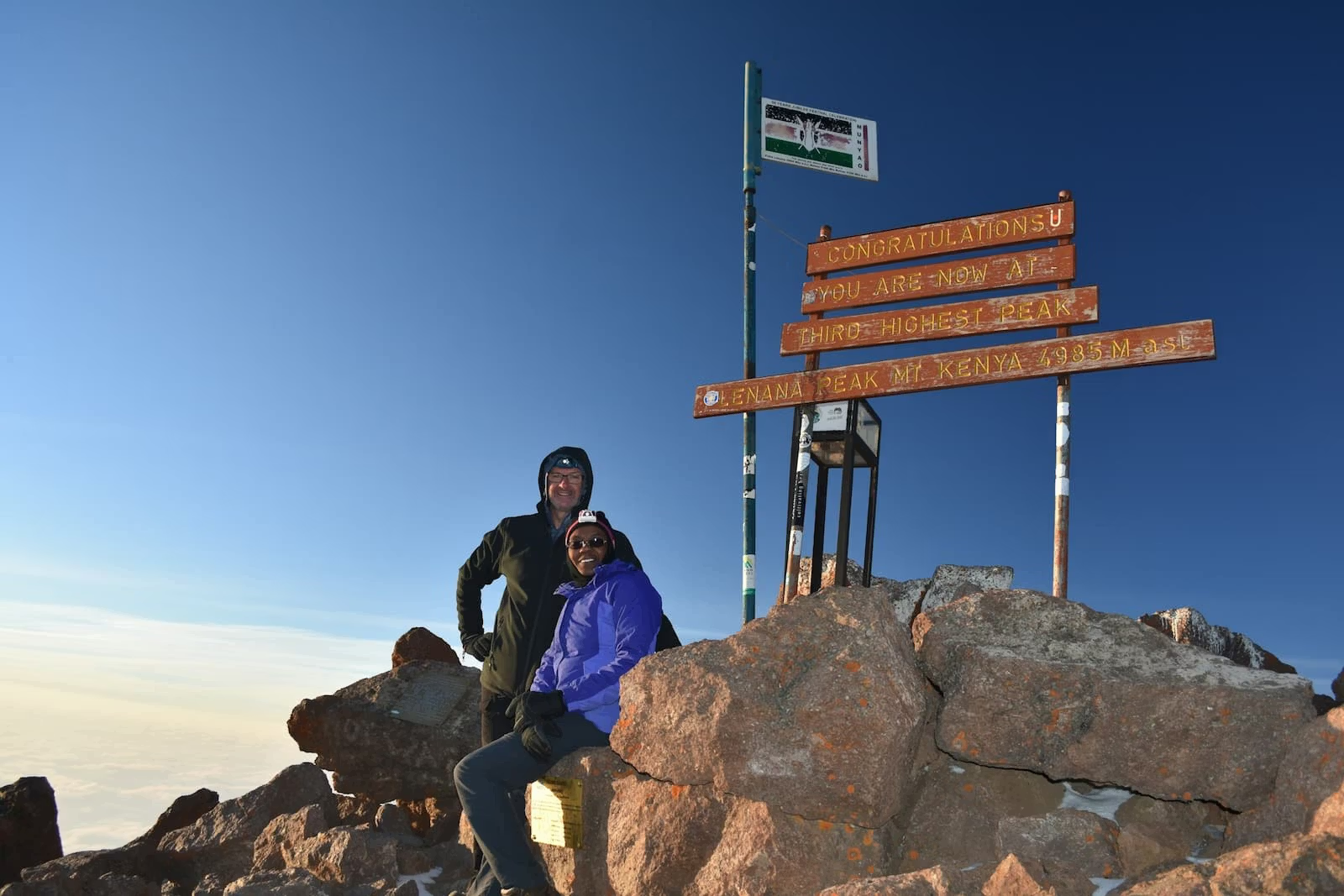
Trekkers at Point Lenana summit on Mount Kenya at 4,985 metres
Trekkers at Point Lenana, Mount Kenya’s main trekking summit.

Best Mountains and Hiking Destinations in Kenya

Mount Kenya is the country’s principal mountain destination and provides the widest range of trekking and climbing experiences. Point Lenana is the main non-technical trekking objective, while Batian and Nelion require specialist mountaineering skills. Several approaches lead into the mountain, so route choice affects scenery, pacing and the overall character of the trek. The Aberdare Range provides a different experience, with montane forest, waterfalls and high moorland rather than a single dominant summit objective. Farther west, the Cherangani Hills offer rolling highlands, forested ridges and walking country that is less commercially developed than Mount Kenya. Together, these areas allow travellers to choose between high-altitude trekking, technical climbing, shorter nature walks and quieter highland exploration.

Kenya Hiking and Mountain Climbing Destinations at a Glance

DestinationHeight / Key ElevationDifficultyTypical Duration
Mount Kenya (Point Lenana) 4,985 m Moderate to challenging high-altitude trekking; no technical climbing required 4–5+ days
Mount Kenya (Batian / Nelion) 5,199 m / 5,188 m Technical mountaineering requiring prior climbing experience Multi-day expedition
Aberdare Range Highland peaks around 4,000 m Easy to challenging depending on trail and conditions Day hikes to multi-day trips
Cherangani Hills Highland walking country Generally moderate; route-dependent Day hikes to multi-day trips

Mount Kenya Point Lenana Trek

Point Lenana is the main trekking objective on Mount Kenya and offers a high-altitude summit experience without the specialist rock-climbing requirements of the mountain’s higher peaks. Multi-day treks pass through forest, heath, moorland and distinctive Afro-alpine landscapes before reaching the upper mountain, making the changing scenery an important part of the experience rather than treating the summit as the only objective. Most itineraries reach Point Lenana using Sirimon, Chogoria or Naro Moru, sometimes combining different ascent and descent routes. The experience is best suited to reasonably fit travellers who want a substantial mountain challenge but are not technical mountaineers. Detailed route choice and altitude preparation are covered in the sections below.

Batian and Nelion Technical Climbs

Batian, at 5,199 metres, and Nelion, at 5,188 metres, are Mount Kenya’s highest technical summits and offer a fundamentally different experience from trekking to Point Lenana. Reaching them involves technical climbing, specialist equipment and more complex expedition logistics, with route and seasonal conditions influencing how an attempt is organised. These peaks are appropriate for experienced mountaineers rather than ordinary high-altitude trekkers. Specialist guiding, previous climbing experience and sufficient expedition time are therefore central to planning. The distinction matters when comparing Mount Kenya itineraries because a “Mount Kenya climb” can describe anything from a non-technical Point Lenana trek to a serious technical summit expedition.

Aberdare Range Hiking

The Aberdare Range offers highland hiking through montane forest, bamboo, valleys, waterfalls and open moorland, providing a distinctly different experience from Mount Kenya’s summit-focused trekking. Walks range from shorter nature hikes to more demanding routes, with trail difficulty influenced by distance, elevation, weather and local conditions. Its main advantage is flexibility. Travellers can incorporate walking into a broader central Kenya itinerary without committing several days to a high-altitude ascent, while nearby wildlife areas and lodge accommodation make hiking relatively easy to combine with safari activities. The Aberdares therefore suit travellers who value forests, waterfalls, highland scenery and wildlife as much as reaching a particular summit.

Hikers walking through the highland landscape of the Aberdare Range in Kenya
Hiking through the dramatic highland scenery of the Aberdare Range.

Cherangani Hills Hiking

The Cherangani Hills provide a quieter hiking alternative in western Kenya, characterised by forested ridges, highland valleys, farmland and extensive views rather than a single famous summit objective. Walking here is more about exploring landscapes and rural highlands than pursuing the high-altitude challenge associated with Mount Kenya. Tourism infrastructure is less concentrated than around Mount Kenya, making good local route planning particularly useful for longer walks. The area is best suited to travellers interested in less-commercial hiking, birdlife and slower exploration, especially those prepared to trade the established trekking infrastructure of Mount Kenya for a quieter and more locally focused highland experience.

Best Mount Kenya Routes: Sirimon, Chogoria and Naro Moru

Mount Kenya’s three principal approaches—Sirimon, Chogoria and Naro Moru—provide noticeably different trekking experiences. Route choice affects scenery, trail character, daily elevation gain and the overall pace of the journey. Sirimon is commonly chosen for its progressive approach, Chogoria for its dramatic landscapes, while Naro Moru provides more direct access to the upper mountain. Combining different ascent and descent routes can also create a more varied trek.

Sirimon Route

The Sirimon Route approaches Mount Kenya from the northwest and is one of the most popular routes for Point Lenana treks. The trail progresses through forest and heath before entering open moorland and the increasingly sparse Afro-alpine environment of the upper mountain. Its landscape changes gradually, giving trekkers time to experience several of Mount Kenya’s ecological zones rather than moving immediately into the higher terrain. Sirimon is frequently used as one half of a Mount Kenya traverse, particularly when paired with Chogoria. This allows trekkers to approach the mountain from one direction and leave through a completely different landscape, adding variety to a multi-day itinerary.

Chogoria Route

Chogoria is particularly valued for scenery, with dramatic valleys, cliffs, high-altitude lakes and expansive Afro-alpine landscapes creating one of Mount Kenya’s most visually varied approaches. It appeals especially to trekkers and photographers who want the journey through the mountain to be as memorable as reaching Point Lenana.

Lake Michaelson surrounded by dramatic cliffs along the Chogoria Route on Mount Kenya
Lake Michaelson and the dramatic Gorges Valley on the Chogoria Route

The route can be used for either ascent or descent and is frequently combined with Sirimon. Some itineraries involve longer walking sections, so travellers should compare daily distances and overall trek design rather than choosing Chogoria solely for its reputation for scenery.

Naro Moru Route

The Naro Moru Route approaches Mount Kenya from the west and provides one of the mountain’s most established and direct approaches towards Point Lenana. This can make it useful for certain itineraries, although its trail character differs substantially from Sirimon and Chogoria. A notable feature is the Vertical Bog, where wet and muddy conditions can make progress slower and more physically demanding than distance alone suggests. Because Naro Moru can also be incorporated into relatively short itineraries, travellers should examine the daily elevation profile carefully and ensure the schedule provides adequate time at altitude.

How Difficult Is Climbing Mount Kenya?

Mount Kenya ranges from a demanding high-altitude trek to serious technical mountaineering, so difficulty should be judged according to the chosen objective. Point Lenana at 4,985 metres requires several consecutive days of walking, significant elevation gain and the ability to cope with colder, more exposed conditions as altitude increases. Good cardiovascular fitness and previous hiking experience are useful, but trekkers do not need the technical climbing background required for the higher summits. Altitude is usually one of the biggest challenges. Reduced oxygen can make walking slower and more tiring even for physically fit travellers, while rain, wind, cold and changing trail conditions can add to the physical demands. A sensible itinerary therefore needs enough time for the body to adjust rather than judging difficulty only by walking distance. Batian and Nelion represent the technical end of Mount Kenya climbing. They require prior climbing experience, specialist equipment and appropriately qualified guides. Travellers should therefore choose their objective according to genuine experience and fitness: Point Lenana for a demanding trekking challenge, and Batian or Nelion for experienced mountaineers seeking a technical expedition.

Best Time to Climb Mount Kenya and Hike in Kenya

The generally drier periods of January to February and July to October are the most practical windows for Mount Kenya trekking and hiking elsewhere in Kenya’s highlands. Drier conditions can make trails easier to manage and improve the likelihood of clearer mountain views, although weather at altitude remains highly changeable. Cold temperatures, cloud, rain and strong winds can occur even during otherwise favourable trekking months. The wetter periods generally bring muddier trails, heavier cloud and more difficult walking conditions, particularly on exposed or poorly drained sections. The best timing also depends on the objective: a Point Lenana trek primarily requires suitable trekking conditions, while technical attempts on Batian or Nelion need more specialised consideration of climbing routes and seasonal mountain conditions. The seasons table below gives travellers a quick comparison of the main planning periods.

SeasonMonthsConditions
Dry Season January–February Best overall conditions on Mount Kenya
Dry Season July–October Good trekking conditions, although mountain weather remains changeable
Rainy Seasons March–June, November–December Wetter trails, heavier cloud and generally more difficult hiking conditions

How Much Does It Cost to Climb Mount Kenya?

The cost of climbing Mount Kenya depends on the objective, route, number of days, group size and level of support. Key expenses can include park fees, guides and porters, mountain accommodation or camping, meals, trailhead transfers and pre- or post-climb stays, while technical expeditions may require specialist guides and equipment. When comparing trips, look at what is included and whether the itinerary allows adequate acclimatisation rather than choosing solely by the lowest advertised price.

Budget and Standard Point Lenana Treks

Budget and standard Point Lenana treks concentrate spending on the essentials: guiding, porter support where included, meals, park access and straightforward mountain huts or camping. Group departures can reduce the per-person cost because transport, guiding and some logistical expenses are shared between trekkers. A lower price should not come at the expense of sensible acclimatisation. Check whether park fees, transfers, meals, guides, porters and accommodation are included, and be cautious about unusually short itineraries designed primarily to reduce the headline cost.

Mid-Range Guided Mount Kenya Treks

Mid-range treks generally provide more flexibility around the core mountain experience, potentially including smaller-group or private guiding, additional acclimatisation time, private transfers and better accommodation before and after the climb. They can also incorporate a Sirimon–Chogoria route combination, allowing travellers to experience different sides of Mount Kenya rather than retracing the same trail. For travellers combining Mount Kenya with a wildlife safari, this level can also make the transition between the mountain and the next destination easier to organise.

Technical Batian and Nelion Expeditions

Batian and Nelion expeditions sit in a higher cost category because they require specialist mountaineering guides, technical equipment, more complicated logistics and sufficient time to respond to mountain conditions. They should therefore be compared on guide experience, expedition structure, safety planning and what equipment is provided rather than price alone. Travellers should confirm whether technical gear, park charges, support staff, transfers and pre- or post-climb accommodation are included so that quotations can be compared accurately.

Hiking AreaPre/Post-Hike BaseOn-Trail AccommodationBest For
Mount Kenya – Nanyuki Hotels, safari lodges and mountain-oriented properties Mountain huts or camping depending on route Comfortable pre/post-climb stays and safari combinations
Mount Kenya – Naro Moru Lodges and trekking bases Mountain huts or camping Access to the Naro Moru side of Mount Kenya
Mount Kenya – Chogoria Local lodges and guest accommodation Camping or hut arrangements according to itinerary Access to the scenic Chogoria Route
Aberdare Range Safari lodges, forest lodges and tree-lodge properties Usually lodge-based for shorter hiking itineraries Combining hiking, wildlife and highland scenery
Cherangani Hills Smaller local accommodation depending on route Route-dependent camping or local stays Quieter, less-commercial highland hiking

What to Expect on a Mount Kenya Trek

A Mount Kenya trek changes significantly as elevation increases, with lower trails passing through forest before reaching heath, moorland and increasingly exposed Afro-alpine terrain. Daily routines generally involve several hours of steady walking, regular breaks, meals and gradual altitude gain, while temperatures become colder as trekkers approach the upper mountain. Understanding acclimatisation, guide support and mountain accommodation before departure helps travellers prepare for the practical realities of a multi-day trek rather than focusing only on reaching Point Lenana.

Altitude and Acclimatisation

Altitude is one of the most important challenges on a Mount Kenya trek, particularly as travellers approach Point Lenana at 4,985 metres. A gradual ascent gives the body more time to adjust to reduced oxygen levels, which is why properly paced itineraries are generally preferable to rushing the mountain simply to reduce the number of trekking days. Good physical fitness makes sustained walking easier but does not guarantee that a traveller will adjust quickly to altitude. Trekkers should therefore follow their guide’s pacing, communicate changes in how they feel and treat acclimatisation as a central part of the itinerary rather than something considered only near the summit.

Guides and Porters

Guides and porters play different but complementary roles during a Mount Kenya trek. A knowledgeable mountain guide manages navigation, daily pacing, route decisions and practical responses to changing weather and trekking conditions, while porters may carry food, camping equipment and other shared supplies depending on the itinerary. This support allows trekkers to concentrate more comfortably on the daily walking and altitude adjustment. When comparing operators, travellers should look beyond the advertised price and consider guide experience, group size, porter welfare, realistic daily distances, emergency procedures and exactly which support services are included throughout the trek.

Mountain Huts and Camping

Accommodation on Mount Kenya is considerably simpler than the safari lodges travellers may use elsewhere in Kenya, and arrangements depend on the selected route and itinerary. Trekkers may stay in mountain huts, campsites or a combination of the two, with facilities becoming increasingly basic at higher elevations. Camping can provide greater flexibility on some routes, while huts offer more permanent shelter but should not be expected to provide hotel-style comfort. Before beginning the trek, travellers should confirm sleeping arrangements, bedding requirements, meals, washing and toilet facilities, and whether tents or other camping equipment are supplied so they arrive with realistic expectations.

Tents at a high-altitude campsite surrounded by rugged Mount Kenya peaks
Camping among Mount Kenya’s high-altitude landscapes.

What to Pack for Mount Kenya

Packing for Mount Kenya should account for changing temperatures and weather as altitude increases. Bring layered clothing, warm upper-mountain layers, waterproof protection, broken-in trekking boots, gloves, headwear, sun protection and a practical daypack for water, snacks and daily essentials. The exact kit should match the season, route and objective, with Point Lenana trekkers following their operator’s equipment list and Batian or Nelion climbers requiring additional specialist climbing gear

How to Combine Mount Kenya with a Kenya Safari

Mount Kenya’s position in central Kenya makes it particularly suitable for combining trekking with a wildlife safari. Laikipia and Samburu are natural additions for travellers continuing north or through central Kenya, while the Masai Mara can be incorporated into a longer itinerary for a contrasting classic savannah experience. The best combination depends on available time, transport arrangements and how much recovery a traveller wants after the mountain. Rather than adding destinations simply to increase the itinerary length, the strongest combinations allow sufficient time for both the climb and the wildlife experience.

Mount Kenya and Laikipia

Combining Mount Kenya with Laikipia creates one of the most practical mountain-and-safari itineraries in Kenya because the two regions sit within the same broader central Kenya circuit. After several days of high-altitude trekking, travellers can shift to game drives, wildlife viewing and conservation-focused activities across Laikipia’s ranches and conservancies. The change from physically demanding mountain days to lodge-based safari activities also provides a useful period of recovery after the trek. This combination is particularly suitable for travellers who want a varied itinerary without immediately undertaking a long transfer to southern or western Kenya after descending Mount Kenya.

Mount Kenya and Samburu

Mount Kenya and Samburu create a striking contrast between cool high-altitude environments and the dry landscapes of northern Kenya. After trekking through forest, moorland and Afro-alpine terrain, travellers can continue towards Samburu for game drives and wildlife viewing in a much warmer ecosystem. The combination adds traditional safari experiences without repeating the landscapes encountered on the mountain, giving the itinerary a clear sense of progression. It works especially well for travellers who want their Kenya trip to remain focused on the central and northern regions rather than travelling immediately to the Masai Mara after completing the climb.

Mount Kenya and the Masai Mara

Combining Mount Kenya with the Masai Mara brings together two of Kenya’s most recognisable landscapes: the high-altitude environment of Mount Kenya and the open savannah of the Mara ecosystem. After completing the trek, travellers can switch from several days of walking to game drives focused on large mammals, predators and seasonal wildlife movements. The two destinations are not immediately adjacent, so realistic transfer planning is important and additional travel time should be incorporated into the itinerary. This combination is best for travellers with enough days to experience both destinations properly rather than shortening the mountain trek simply to fit the Mara into a limited schedule.

Aberdares and Central Kenya

The Aberdares provide a gentler alternative for travellers who want hiking and wildlife without committing to a high-altitude Mount Kenya trek. Forest walks, waterfalls and moorland scenery can be combined with lodge stays and wildlife viewing within the wider central Kenya highlands, producing a more relaxed active-safari itinerary. This combination can suit travellers with limited trekking time, those who prefer shorter walking days or visitors who want hiking to complement rather than dominate their holiday. It also introduces a different side of Kenya’s mountain landscape while avoiding the greater altitude demands associated with reaching Point Lenana.

What to Pack for Mount Kenya

Packing for Mount Kenya requires preparation for dramatically different conditions between the lower slopes and the upper mountain. Lightweight trekking clothing works well at lower elevations, but temperatures fall considerably as trekkers climb higher, particularly during early mornings and around Point Lenana. A practical layering system should therefore include moisture-managing base layers, insulating clothing and waterproof outer protection, together with broken-in hiking boots, warm socks, gloves and suitable headwear. Sun protection is equally important at altitude, so sunglasses, sunscreen and a hat should remain accessible during the day. Trekkers should also carry a comfortable daypack containing water, snacks, rain protection and personal essentials needed while walking, while larger equipment may be transported according to the trek’s porter arrangements. Sleeping bags and other camping equipment depend on whether the itinerary uses huts, campsites or both, so travellers should confirm exactly what the operator provides before packing. Point Lenana trekkers should follow a route- and season-specific equipment list, while anyone attempting Batian or Nelion will require additional technical climbing equipment appropriate to the expedition.

How Many Days Do You Need for a Mount Kenya Trek?

Most Point Lenana itineraries take approximately four to five days, but the right duration depends on the route, starting point, daily elevation gain and time allowed for acclimatisation. A longer itinerary is not simply about spending more time on the mountain: an additional day can create a more gradual ascent and reduce pressure to gain altitude too quickly. It can also make route combinations such as ascending through Sirimon and descending through Chogoria more practical, allowing trekkers to experience different landscapes rather than retracing the same trail. Travellers combining Mount Kenya with a wildlife safari need to consider the entire journey rather than only the trekking days. Time should be allowed for arrival, pre-climb preparation, the mountain itself, recovery and transfers to destinations such as Laikipia, Samburu or the Masai Mara. Compressing the trek simply to add another safari destination can weaken the mountain experience and reduce valuable acclimatisation time. For a combined itinerary, it is better to visit fewer places properly than to rush both the climb and the safari.

Which Kenya Hiking or Climbing Experience Is Right for You?

The right Kenya hiking or climbing experience depends on fitness, previous mountain experience, available time and the type of landscape a traveller wants to explore. Point Lenana is the strongest choice for trekkers seeking a major high-altitude objective without technical climbing, while Batian and Nelion are appropriate only for experienced mountaineers with the necessary technical skills. Travellers primarily interested in scenery should also consider route choice, with a Sirimon–Chogoria combination providing a more varied Mount Kenya journey than simply following the same approach in both directions. Mount Kenya is not the only choice. The Aberdare Range works better for travellers wanting shorter forest, waterfall and moorland hikes that can fit naturally into a wildlife safari, while the Cherangani Hills appeal to those seeking quieter highland walking away from Kenya’s busiest trekking routes. Travellers who want both a substantial mountain challenge and wildlife viewing can combine Mount Kenya with Laikipia or Samburu. The comparison table below can then work as the decision tool, summarising these choices rather than repeating the preceding explanation.

Traveller PriorityRecommended ExperienceWhy It Fits
First high-altitude trekking experience Mount Kenya – Point Lenana Major high-altitude objective without technical summit climbing
Technical mountaineering challenge Mount Kenya – Batian or Nelion Serious climbing objective requiring prior technical experience
Scenic multi-day Mount Kenya trek Sirimon–Chogoria combination Contrasting routes create a more varied mountain journey
Forest and moorland hiking with wildlife Aberdare Range Easy to integrate with wildlife viewing and lodge stays
Quieter highland exploration Cherangani Hills Less-commercial walking away from Mount Kenya’s main trekking routes
Hiking plus wildlife safari Mount Kenya + Laikipia or Samburu Strong contrast between mountain trekking and wildlife viewing

Frequently Asked Questions About Kenya Mountain Climbing and Hiking Safaris

Do You Need Technical Climbing Skills for Mount Kenya?

Not for Point Lenana. It is a high-altitude trekking objective rather than a technical summit, although good fitness and appropriate acclimatisation remain important. Batian and Nelion require genuine technical climbing experience.

Point Lenana trekking itineraries commonly take around four to five days, although route and acclimatisation schedules vary. Technical summit expeditions require separate planning and may take longer

There is no single best route for every traveller. Sirimon is widely used for a steady approach, Chogoria is especially valued for scenery, and Naro Moru is more direct. Combining Sirimon and Chogoria can create a particularly varied trek.

January–February and July–October are generally preferred because conditions are usually drier, but mountain weather remains changeable throughout the year. Technical climbers should also consider route-specific seasonal conditions.

Yes. Laikipia and Samburu are particularly natural additions, while the Masai Mara can be incorporated into a longer itinerary. Combining mountain trekking with wildlife viewing gives the journey a broader range of Kenyan landscapes and experiences.

//
Our customer support team is here to answer your questions. Ask us anything!
👋 Hi, how can I help?
Scroll to Top