Tsavo West National Park: Wildlife, Mzima Springs and Things to Do
Tsavo West National Park feels completely different from the broad, open plains of Tsavo East. Here, the landscape rises and falls through wooded hills, rocky ridges, old lava fields, springs, wetlands and open savannah. You can begin the morning watching elephants and buffalo on a game drive, walk beside the clear water at Mzima Springs, cross a black volcanic landscape at Shetani Lava Flow and finish the day looking towards Mount Kilimanjaro when the clouds lift.
The park covers approximately 9,065 square kilometres in southeastern Kenya and forms part of the much larger Tsavo Conservation Area. The Nairobi-Mombasa highway separates it from Tsavo East, making the two parks easy to combine while still giving you two very different safari experiences. Tsavo West also holds one of Kenya’s most important black rhino conservation areas, while Lake Jipe on the Tanzania border adds hippos, waterbirds and a quieter side of the park that many shorter safaris never reach. This is not a park we rush through. Its strength lies in moving between distinct places rather than driving one long wildlife circuit and expecting every highlight to appear beside the road.
Tsavo West National Park at a Glance
Where Is Tsavo West National Park?
Tsavo West lies in Taita-Taveta County in southeastern Kenya, west of the Nairobi-Mombasa highway and opposite Tsavo East National Park. Mtito Andei is one of the main gateways into the park. It lies approximately 240 kilometres from Nairobi and 250 kilometres from Mombasa. Allow roughly 4 to 5 hours by road from either direction, depending on traffic, stops and where your safari begins. The park can also be entered from the Amboseli side through Chyulu Gate, which makes Amboseli and Tsavo West one of the most natural road combinations in southern Kenya. Other access points serve the western and southern sections, including Lake Jipe, Maktau and Ziwani. This location also works well for travellers continuing towards Kenya’s coast. You can move from Nairobi or Amboseli through Tsavo West, add Tsavo East if time allows and then continue towards Mombasa or Diani rather than treating the beach and safari as completely separate journeys.
Park Size, Landscape and Access
Tsavo West covers approximately 9,065 square kilometres. The park is smaller than Tsavo East but visually more varied. You move between open grassland, acacia woodland, wooded hills, volcanic ridges, lava fields, freshwater springs and wetlands close to the Tanzanian border. That variety is what gives Tsavo West its character. Wildlife can disappear quickly behind thicker vegetation, so game viewing does not always feel as open as it does in Tsavo East. In return, you gain landscapes that change dramatically within one day. The higher ground also opens views towards Mount Kilimanjaro when the weather is clear, particularly during the early morning before haze and cloud build over the mountain.
Why Visit Tsavo West National Park?
Mzima Springs and the Underwater Viewing Area
Mzima Springs is one of those places that immediately changes the mood of a Tsavo safari. After driving through dry bush and volcanic country, you arrive at clear freshwater pools surrounded by palms, thick vegetation and birdlife. The water originates from rainfall on the Chyulu Hills, filters through porous volcanic rock underground and eventually emerges here as a series of clear springs. A short guided walk leads from the parking area towards the pools and underwater viewing area. From behind reinforced glass, you can look beneath the surface at fish moving through exceptionally clear water. Hippos can also use the pools, although no particular animal should be expected to appear directly in front of the viewing windows during every visit. Above water, watch the banks and surrounding vegetation for hippos, crocodiles, monkeys and birds. You are outside the vehicle here, so follow the ranger’s instructions throughout the walk. Hippos are powerful wild animals, and the escort is part of visiting the springs safely.
Black Rhinos in Tsavo West
Rhino conservation has become an even bigger part of Tsavo West. For many years, visitors knew the protected area around the Ngulia Hills as the Ngulia Rhino Sanctuary. That original 92-square-kilometre sanctuary played an important role in rebuilding Tsavo’s black rhino population after the devastating poaching years. The protected rhino landscape has now expanded dramatically. The Tsavo West Rhino Sanctuary covers approximately 3,200 square kilometres, giving black rhinos far more room to establish territories, feed and breed while remaining under intensive protection. This does not mean that rhino sightings are guaranteed. The larger protected range actually means the animals have more space to move, so finding them can still require patience. What Tsavo West gives you is an opportunity to experience a major black rhino conservation landscape while still enjoying the wider park rather than visiting a small enclosure built solely around one species.
Shetani Lava Flow and Volcanic Landscapes
Shetani Lava Flow looks almost unnatural the first time you see it. A broad field of dark, jagged lava spreads across the landscape, with sparse vegetation struggling to establish itself between the rocks. The contrast with Tsavo’s grassland and bush makes the stop memorable even when no wildlife is present. The lava was produced by relatively recent volcanic activity, and the rough black surface still looks remarkably fresh in places. The name Shetani means devil, reflecting local stories that associated the violent volcanic event with supernatural forces. You can walk on designated areas with your guide, but the surface is sharp and uneven. Wear proper footwear and do not wander away from established visitor areas.
Kilimanjaro Views From Tsavo West
Mount Kilimanjaro is not visible every day, but when the mountain appears above Tsavo West it changes the entire landscape. The strongest chance generally comes early in the morning before heat, cloud and haze build across the horizon. The Kilaguni area is particularly well positioned for these views. You can sometimes watch elephants, buffalo or other wildlife with the mountain rising beyond the plains, giving you a photographic setting very different from the flatter country of Tsavo East. We would never promise Kilimanjaro. Weather decides whether you see it. When the mountain is hidden, Tsavo West still has enough volcanic scenery, springs, wildlife and hills to carry the safari without it.
When to Visit Tsavo West
The dry seasons, from June through October and again from January through February, bring the clearest roads and the most predictable game viewing, as animals concentrate around Mzima Springs and the park’s other permanent water sources. These months also offer the best odds of a clear Kilimanjaro view, since haze and cloud cover build up more readily during wetter periods. The long rains from March to May turn Tsavo West’s hills a rich green and bring out the park’s volcanic scenery in sharper contrast, though some of the steeper, rockier tracks become genuinely difficult, and self-drive travelers should factor in more conservative routing during these months.
The short rains around November are brief and localized, and this period carries one particular claim to fame: misty November and December nights around Ngulia Safari Lodge draw enormous numbers of migrating Palearctic birds toward the lodge’s lights, disoriented by the fog, and researchers have run a bird-ringing programme here for decades to study these movements. Guests staying at the lodge during this window can sometimes observe the ringing process directly, a genuinely unusual activity that’s specific to this exact time and place. Because Tsavo West sees fewer visitors overall than Tsavo East or the Mara, even peak season here rarely feels crowded at the main landmarks, which is worth factoring in if you’ve found other popular parks too busy in the past.
| Season | Months | Conditions | Best For |
|---|---|---|---|
| Long dry season | June – October | Clear roads, best Kilimanjaro visibility | First-time visitors, photographers wanting clear mountain views |
| Short dry season | January – February | Warm, dry, strong game viewing | Travelers combining a festive-season coast and safari trip |
| Long rains | March – May | Lush green hills, some rough tracks | Photographers and budget-conscious travelers accepting some disruption |
| Short rains | November – December | Misty nights, bird-ringing season at Ngulia | Birders and travelers interested in the migration research programme |
Best Things to Do in Tsavo West National Park
Tsavo West rewards travelers who treat it as a collection of distinct landmarks rather than a single continuous game drive, since much of what makes this park special sits in specific, named locations rather than spread evenly across the landscape. Here’s how we typically sequence a client’s time here.
Visit Mzima Springs
A short, ranger-guided walk from the car park leads to Mzima Springs’ underwater viewing chamber, where reinforced glass lets you watch hippo, large barbel fish and occasionally crocodile from just a few feet away, submerged in water so clear it barely looks real. An armed ranger accompanies every visit, both because hippos are genuinely dangerous on land and because the walk passes close to the water’s edge. It’s one of the most distinctive wildlife encounters in Kenya and consistently ranks as a highlight for clients who’ve done several previous safaris elsewhere.
Search for Black Rhinos
Tsavo West’s protected rhino landscape is now vast, so the experience should not be sold as a quick drive into a small enclosure where an animal is certain to appear. Work with your guide. Fresh tracks, dung, recent ranger information and knowledge of the terrain all help determine where to search. A rhino sighting is rewarding precisely because the animals are living within a large protected landscape rather than waiting around one predictable viewing point. The wider story matters too. Tsavo once held thousands of black rhinos before poaching devastated the population. Seeing one today carries more weight when you understand how much conservation work has gone into rebuilding that population.
Walk Across Shetani Lava Flow
Shetani is one of the easiest places to appreciate Tsavo West’s volcanic history. Step out at the designated area and the surface changes immediately beneath your feet. Black fractured lava stretches away from the road with very little vegetation softening the scene. A short walk is enough to understand the scale. Do not underestimate the heat or roughness of the rock during the middle of the day. Proper footwear matters. This is a landscape stop rather than a wildlife activity, which is exactly why it adds variety to a Tsavo West safari.

Climb Chaimu Hill
Chaimu gives you one of the stronger opportunities to leave the vehicle and see Tsavo from above. The volcanic hill rises close to the central safari routes and provides views across surrounding plains and lava country. The climb is short, but loose volcanic ground and the heat can make it more demanding than the distance suggests. Go early when temperatures are lower. The reward is perspective. From above, you begin to understand how the black lava, dry bush, hills and open wildlife country fit together. On a clear day, the wider horizon can also open towards Kilimanjaro.
Take a Boat Ride on Lake Jipe
Lake Jipe sits along the Kenya-Tanzania border in one of Tsavo West’s quieter areas. The lake gives you another complete change of pace. A boat ride takes you onto wetland habitat used by hippos, crocodiles and a wide variety of waterbirds. The Pare Mountains rise on the Tanzanian side, adding a strong scenic backdrop to the lake. Go early in the morning or later in the afternoon when temperatures are cooler and bird activity is stronger. Lake Jipe is farther from the busiest central Tsavo West circuit, so give it enough time rather than adding it as a rushed final stop.
Bird Ringing at Ngulia Safari Lodge
During misty nights in November and December, migrating Palearctic birds are drawn toward the lights of Ngulia Safari Lodge, disoriented by fog on their journey south, and researchers have run a bird-ringing programme here for decades to study these movements. Guests staying at the lodge during this specific window can sometimes observe the process directly, a genuinely rare opportunity to see migration research in action rather than simply read about it.
Take an Early Morning Game Drive
General game drives tie all the separate Tsavo West experiences together. Elephants, buffalo, giraffes, zebras, lions, leopards and several antelope species occur across the park. Greater and lesser kudu are particularly rewarding when you find them among thicker woodland. The terrain changes constantly, so animals can disappear behind hills and vegetation more quickly than on an open Tsavo East plain. Early morning provides cooler temperatures and stronger general wildlife activity. Late afternoon works equally well as animals begin moving again after the hottest part of the day. Do not rush between the named attractions so quickly that you forget you are still inside a major wildlife park.

Photograph Kilimanjaro and Tsavo’s Volcanic Landscapes
Tsavo West gives photographers more variety than a straightforward big-game safari. You have black lava at Shetani, exceptionally clear water at Mzima, green hills after the rains, Lake Jipe wetlands and wildlife moving through wooded and open country. Then there is Kilimanjaro. When the mountain appears in the early morning, use it as part of the wider landscape rather than waiting only for an animal to walk perfectly in front of it. The mountain can disappear quickly. Take the photograph while the conditions are working.
Where to Stay at Tsavo West
Accommodation at Tsavo West ranges from a historic lodge with genuine Kilimanjaro views to intimate camps built directly around natural springs, along with simpler options for self-drive and budget travelers. Properties cluster around a few distinct areas: near Kilaguni in the park’s center, around Ngulia in the hills, and near Ziwani and Lake Jipe closer to the Tanzanian border. The choice for most clients comes down to which of the park’s landmarks matter most. A lodge near Kilaguni puts you closest to Mzima Springs and offers the best mountain views, while a property near Ngulia sits right by the rhino sanctuary and, in season, the bird-ringing programme.
Kilaguni Serena Lodge
Property Style
Kilaguni Serena LodgeLocation
Central park, near Mzima SpringsBest Suited For
Travelers wanting Kenya's first safari lodge, strong Kilimanjaro views and easy access to the springs
Ngulia Safari Lodge
Property Style
Ngulia Safari LodgeLocation
Ngulia Hills, overlooking a waterholeBest Suited For
Birders and travelers interested in the bird-ringing programme, plus reliable passive game viewing
Finch Hatton’s Luxury Camp
Property Style
Finch Hatton’s Luxury CampLocation
Built around natural springsBest Suited For
Luxury travelers wanting an elegant, spring-fed setting with a strong sense of place
Voyager Ziwani
Property Style
Voyager ZiwaniLocation
Near Lake Jipe, western sectionBest Suited For
Travelers prioritizing birdlife and a quieter, less-visited part of the park
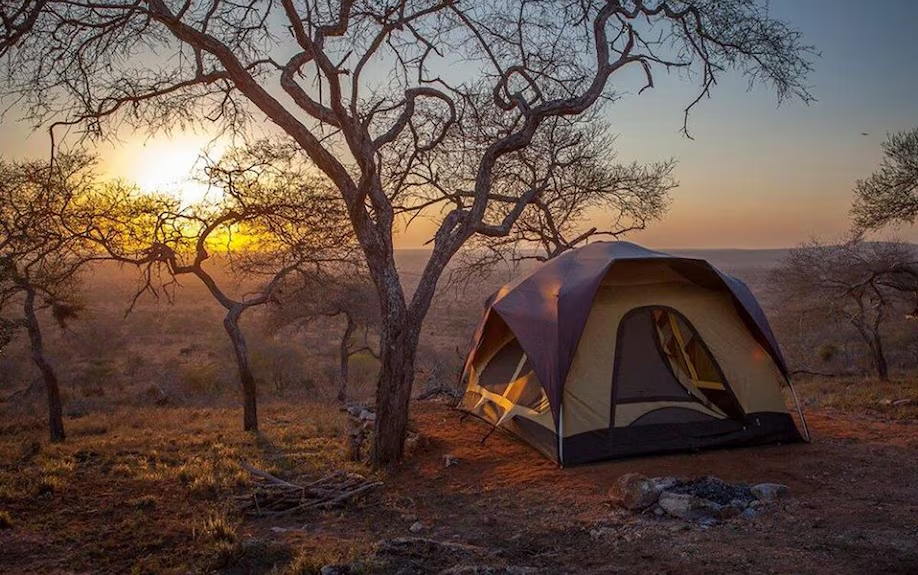
Budget Campsites Near Mtito Andei
Property Style
Budget campsites near Mtito AndeiLocation
Park peripheryBest Suited For
Self-drive and budget-conscious travelers comfortable with a simpler stayKenya Safari Packages Including Tsavo West
1 Day Nairobi City Tour & National Park
Combine Nairobi's city highlights with a visit to Nairobi National Park for a convenient one-day wildlife and city experience.
VIEW TOUR →
3 Days Lake Nakuru Safari from Nairobi
Explore Lake Nakuru National Park and discover its wildlife, scenic Rift Valley landscapes and famous rhino sightings.
VIEW TOUR →
4 Days Lake Nakuru & Masai Mara Safari
Combine Lake Nakuru's diverse wildlife with the expansive plains and exceptional game viewing of the Masai Mara.
VIEW TOUR →
6 Days Masai Mara & Amboseli Safari
Experience the wildlife-rich Masai Mara together with Amboseli's famous elephants and spectacular Mount Kilimanjaro scenery.
VIEW TOUR →
7 Days Kenya Safari: Masai Mara, Amboseli & Lake Nakuru
Discover three of Kenya's iconic safari destinations, combining the wildlife of Masai Mara, Amboseli and Lake Nakuru.
VIEW TOUR →
8 Days Magical Kenya Safari from Nairobi
Discover Kenya's diverse landscapes and wildlife on an extended safari from Nairobi, combining several of the country's remarkable destinations.
VIEW TOUR →Frequently Asked Questions
Can you see Kilimanjaro from Tsavo West?
On clear days, yes, particularly from the area around Kilaguni and in the early morning before haze builds along the horizon.
It’s never guaranteed, since visibility depends entirely on weather and cloud cover, and we’re always upfront with clients that a mountain view is a bonus rather than a promise.
Is Tsavo West good for seeing rhino?
Yes, and it’s one of the more reliable places in Kenya to do so. The fenced Ngulia Rhino Sanctuary within the park protects a monitored population of black rhino, delivering considerably better odds than an unfenced park where rhino roam across a much wider, harder-to-search area.
What is Mzima Springs and is it safe to visit?
Mzima Springs is a crystal-clear, spring-fed pool with an underwater viewing chamber where you can watch hippo and fish through reinforced glass.
It’s entirely safe when visited as intended, with an armed ranger escorting the short walk from the car park, a standard precaution given the resident hippo population rather than a sign of unusual risk.
What's the difference between Tsavo West and Tsavo East?
Tsavo West is smaller, hillier and greener, known for volcanic features, Mzima Springs and a dedicated rhino sanctuary, while Tsavo East is larger, flatter and more open, known for red elephants and the Yatta Plateau. Many travelers combine both for a fuller picture of the wider Tsavo ecosystem.
How far is Tsavo West from Nairobi and Mombasa?
Roughly four hours by road from Nairobi to the Mtito Andei Gate, and a similar journey time from Mombasa via the Tsavo Gate near Voi, making it just as workable as Tsavo East for travelers combining a safari with a coastal beach stay.
When is the best time to visit Tsavo West?
The dry seasons, from June through October and January through February, offer the clearest roads and the best odds of a clear Kilimanjaro view.
Birders specifically interested in the bird-ringing programme should target November or December, when misty nights draw migrating Palearctic birds toward Ngulia Safari Lodge.
Can Tsavo West be combined with Amboseli or Tsavo East?
Yes, and this is one of the most natural circuits in southern Kenya. Amboseli, Tsavo West and Tsavo East sit close enough together by road to combine into a single itinerary, giving travelers Kilimanjaro views, volcanic scenery, reliable rhino sightings and open plains game viewing all within one trip.