How To Get To Mount Kilimanjaro National Park?
How To Get To Mount Kilimanjaro National Park? Accessing Mount Kilimanjaro National Park, which is a major destination for Tanzania safaris and mountain climbing expeditions, is easily done via air and road transportation modes. One can fly directly to Kilimanjaro International Airport (JRO), which is located just a few kilometers south of Mount Kilimanjaro and the national park.
Several international flights operate directly to Kilimanjaro International Airport. These include Turkish Airlines from Istanbul, Precision Air from Nairobi, Kenya Airways from Nairobi, KLM from Amsterdam, Qatar Airways from Doha, Condor Air from Frankfurt, Ethiopian Airlines from Addis Ababa, and RwandAir from Kigali. These direct flights have made it easier for international tourists seeking to explore the world-famous Tanzania safaris and Kilimanjaro mountain climbing adventures.
For those coming from other countries that do not have direct flights to Kilimanjaro International Airport, there are other alternatives. Tourists can fly to either Dar es Salaam, which is the largest city in Tanzania, or Abeid Aman Karume International Airport in Zanzibar, and then take a domestic flight to Kilimanjaro International Airport. There are domestic flights running 24 hours, so it is possible to fly to Kilimanjaro from any part of the country at your convenience.
Additionally, visitors may choose to fly into other East African countries including Kenya (Jomo Kenyatta International Airport), Rwanda (Kigali International Airport) and Uganda (Entebbe International Airport). From these airports, one can connect to Tanzania through Kilimanjaro International Airport, giving travelers a multitude of possibilities and options to go out and discover the diverse wildlife as well as the mountainous area of Tanzania.
Frequently Asked Questions About a Tanzanian Safari in Mount Kilimanjaro National Park
What is Mount Kilimanjaro national park famous for?
Mount Kilimanjaro is famous for being the highest free-standing peak on the planet and the highest peak on the African continent. It is an important landmark within Tanzania safaris and an exciting destination for adventure and nature enthusiasts worldwide. The peak comprises three volcanic cones: Mawenzi, Shira, and Kibo. While Mawenzi and Shira are not active volcanoes, Kibo, which is the highest peak on the mountain, is dormant and has the capacity to erupt some day in the future.
It is worth noting that Kilimanjaro is famous for its rich wildlife and natural environment. The forests around the peak are inhabited by vital species of wild animals, making it an important landmark for eco-tourism and safaris. Additionally, the peak offers vital resources such as fresh and clean air and water from the mountains, which are advantageous to the local communities and Tanzanian nationals residing around the peak. All these natural attributes make Kilimanjaro an important landmark for those touring the incredible landscapes within Tanzania.
What is the climate and weather conditions of Mount Kilimanjaro
The climate and weather conditions of Mount Kilimanjaro and its surrounding bush regions and rainforests have an annual temperature variation of around 70 to 80 degrees Fahrenheit, or 21 to 27 degrees Celsius. As Mount Kilimanjaro is located close to the equator, the temperature remains constant over the year. The warmest period of the year ranges from January to March.
On the other hand, the temperature changes drastically as one moves towards the peak of Mount Kilimanjaro. At the peak of Mount Kilimanjaro, the climate resembles an arctic environment. At night, the temperature may fall to as low as -20 degrees Fahrenheit, or -29 degrees Celsius. This variety of weather conditions makes it impossible to categorize this region under a single type of climate.
The wettest period of the year ranges from November to December and March to May. During this period, the rainfall averages around 13.8 inches. On the other hand, the driest period of the year ranges from June to October. During this period, the rainfall may fall to as low as 0.6 inches. The rainfall gradually decreases over the year due to the geographic features of the park and its location close to the equator.
The humidity level is relatively high throughout the year, and the range of humidity is between 57 and 77 percent. In general, humidity is usually high in the spring and summer seasons and low in fall and winter. This high humidity and rainfall are responsible for the formation of fog, especially in the rainforests surrounding Kilimanjaro.
The climate is typically influenced by the northeastern trade winds from May to October and by the southeastern trade winds, which have a minimal influence, between November and March. This causes rainfall to be abundant in the spring and scarce in summer, autumn and winter.
What types of wildlife can I expect to see during a safari?
During a Tanzania safari to Kilimanjaro National Park, tourists can look forward to seeing a variety of wildlife, aside from the natural beauty of the mountain. Some of the animals that can be spotted in the park include warthogs, hippos, impalas, dik-diks, zebras, elephants, buffaloes, and giraffes.
Less common animals that can be spotted in the park include elands and gazelles. For the bird lovers, there are over 200 species of birds to look out for, such as the African Sacred Ibis, Crowned Hornbill, Little Bee-eater, Gray-headed Kingfisher, Moustached Tinkerbird, African Paradise-Flycatcher, Yellow-breasted Apalis, Kilimanjaro White-eye, Violet-backed Starling, Abyssinian Ground-Thrush and Ashy Flycatcher among others. In addition, the park is also home to a variety of primates, such as baboons, blue monkeys, and black-faced monkeys. While big game such as lions and leopards is not commonly spotted, they are expected to appear, although not as frequently as in other parks in Tanzania. This is mainly in the southern regions of Kilimanjaro National Park.
What can I pack for a Tanzania safari in Mount Kilimanjaro National Park
When planning to go on a safari in Mount Kilimanjaro National Park, it is essential to consider the appropriate gear to pack based on the activities to be done and the time of the year. For daytime activities, shirts, shorts, and hats are recommended. For early morning and evening activities, it is essential to consider appropriate gear to keep one warm.
Also, walking shoes, sunglasses, and sunscreens are vital in protecting oneself from the sun during Tanzania safaris. When planning to climb Mount Kilimanjaro, one should consider purchasing appropriate gear such as thermal clothes, gloves, sleeping bags, a headlamp, and personal hygiene products to ensure a safe and enjoyable climb. Furthermore, binoculars and cameras are vital in enhancing the safari experience in Tanzania. One should also consider carrying insect repellents and personal medications to ensure a smooth and enjoyable safari experience in Tanzania.
Best time to visit Mount Kilimanjaro National Park
The best time for visiting the mountain for trekking and climbing activities is during the dry seasons, which occur from June to October and from the end of December to early March. This time is the best for going on mountain Kilimanjaro safaris and climbing the mountain, as the weather conditions are good and the routes are less slippery.
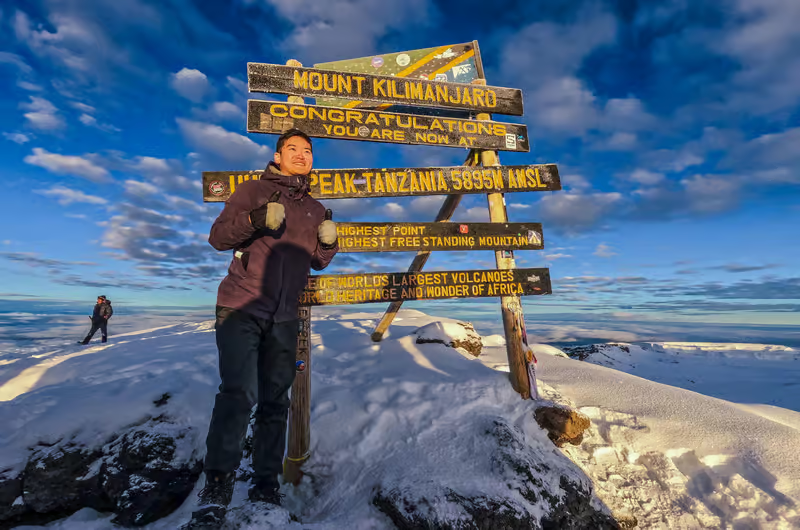
It would be wise to avoid visiting the mountain in November and March to April, as it would be the time for the rainy seasons. This time would be challenging, as the forest routes would be slippery, while the Western Breach route would be covered with snow. It would be wise to plan your Tanzania safari and climbing the mountain during the dry season, which would be fun.
Why book with Elephant Whispers Safaris for your Mount Kilimanjaro hiking in Tanzania?
Elephant Whispers Safaris has vast experience in delivering exceptional safari and adventure travel experiences in Tanzania. We combine Tanzania’s premier safaris with eco-friendly and luxurious high-end safaris that promote biodiversity and sustainability.
Our safaris include gorilla trekking, chimpanzee trekking, Big 5 safaris and game viewing, Mountain Hiking, Boat cruises excursions, and Cultural encounters to ensure that you have a complete East African Safari experience. Our safaris are not limited to Tanzania; we also have safaris to other premier destinations such as Kenya, Uganda, and Rwanda. Do not hesitate to contact us for more information on how to go on a Tanzania safari in Mount Kilimanjaro